
Great Overland Journey in the Land of the Nomads 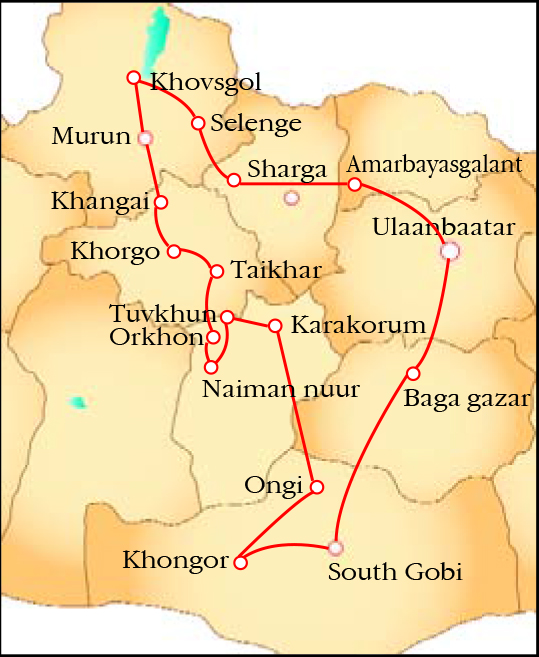
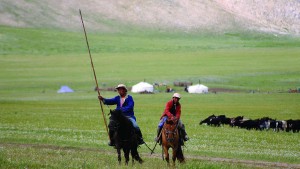
The Ger has been used since the Mongols started nomadic way of life style with animal husbandry. A Ger consists of felt covers (deever, tuurga), wooden columns (bagana), toono (a square window), uni or thin wooden poles, floor, khana or wall (wooden lattice attached together with animal’s hide ropes) and ropes. Most of Ger materials are made out of felt-sheep wool, ropes-camel or sheep wool, horse or yak’s tail, and of course wood. A usual Mongol ger has 5 khanas and 88 unis.
 Day 1: Ulaanbaatar
The Mongolei Reisen crew will greet you at the Buyant-Ukhaa International Airport for transfer to the 4 star hotel, conveniently situated in downtown Ulaanbaatar. After freshening up from your trip, we will spend the day touring some of the capital’s most noteworthy sites starting out at the capital of Mongolian Buddhism, Gandan Monastery. The monastery was one of the few preserved through the 20th century and features a spectacular 25 meter, 20 ton statue of the Megjjd Janraysig Buddha. From here, we will go to the Natural History Museum which holds the skeletons of several of the unique dinosaurs discovered in Mongolia, including the famed ‘Fighting Dinosaurs’ skeletons – considered to be one of the most unique in the world. The heart of Ulaanbaatar, Sukhbaatar Square, is just a short walk away. Here we will see the statue of Sukhbaatar, the hero of the Mongolian revolution, the Parliament house, National Opera, and City Hall. Afterwards we’ll isit Zaisan Hill, which offers great views of the
city. In the evening, you will attend a performance of traditional dancing and khoomii (Mongolian throat singing). Overnight in hotel. (L, D)
Day 2: Baga Gazriin Chuluu
We explore the intriguing rock formations at Baga Gazriin Chuluu, discovering the secret caves and openings in which Buddhist monks hid during the religious persecutions of the 1930s. Overnight in ger camp (B, L, D)
Day 3: South Gobi Desert
En route to the south Gobi we travel by van through the exotic landscape of the world’s coldest desert – a magnificent expanse of mountains, rock, sand and oases, dotted with camels and yurts. Overnight in ger camp (B, L, D)
Day 4: Vulture’s Gorge (Khongoryn Els Sand Dunes)
We spend the day touring the magnificent Gobi Gurvan Saikhan national park where we’ll visit the remarkable “Vulture’s Gorge” within the Gobi Gurvan Saikhan National Park, an exotic setting of green meadows and dense glaciers situated deep within the arid Gobi. At times, the caverns fill with several meters of ice, forming a stark contrast to
the desert surrounding it. If were lucky, we might see some of this area’s abundant wildlife, including the rare argali sheep and mountain goat. From here we continue to Khongoriin Els, Mongolia’s largest sand dunes – reaching heights of approximately 800 meters and known locally as the “singing dunes” because the sands produce an erie rumbling sound slowly in the wind. Overnight in ger camp (B, L, D)
Day 5: Flaming Cliffs / Ongi Monastery
One of Mongolia’s more noteworthy sites is the ancient rock formations at Bayanzag, made famous by American scientist Roy Chapman Andrews’s discovery here of complete dinosaur skeletons and eggs in the 1920s. From here we travel to the site of Ongi Monastery – formerly home to a community of more than 500 Buddhist monks – whose ruined structures testify to the devastating religious purges of the 1930s. On the way to Ongi Monastery you will have the opportunity to visit a local camelbreeding family and learn about their unique nomadic lifestyle. Overnight in ger camp (B, L, D)
Day 6: Karakorum / Erdene Zuu Monastery
Our next stop is Karakorum, the former capital of the world’s greatest land empire, established by Chinggis Khaan. Here we will tour the fascinating Erdene Zuu Buddhist Monastery, a religious complex spanning over 400 square meters surrounded by 108 stupas, which, at its peak, was home to over 1000 monks. The original monastery was destroyed in the communist purges of the early 20th century but work has been carried out to rebuild the monastery on its original foundation. It was first established on the ruins of Karakorum in 1586 by Abtai Sain Khan the grandfather of Saint Zanabazar, as the first architectural example of a new style of Buddhism he founded called “Yellow” Buddhism. The site has some of the best works of religious art and architecture in Mongolia and evening strolls through the grounds provide a great opportunity to immerse yourself in the amazing history of the city. Overnight in ger camp (B, L, D)
Day 7: Tuvkhun Monastery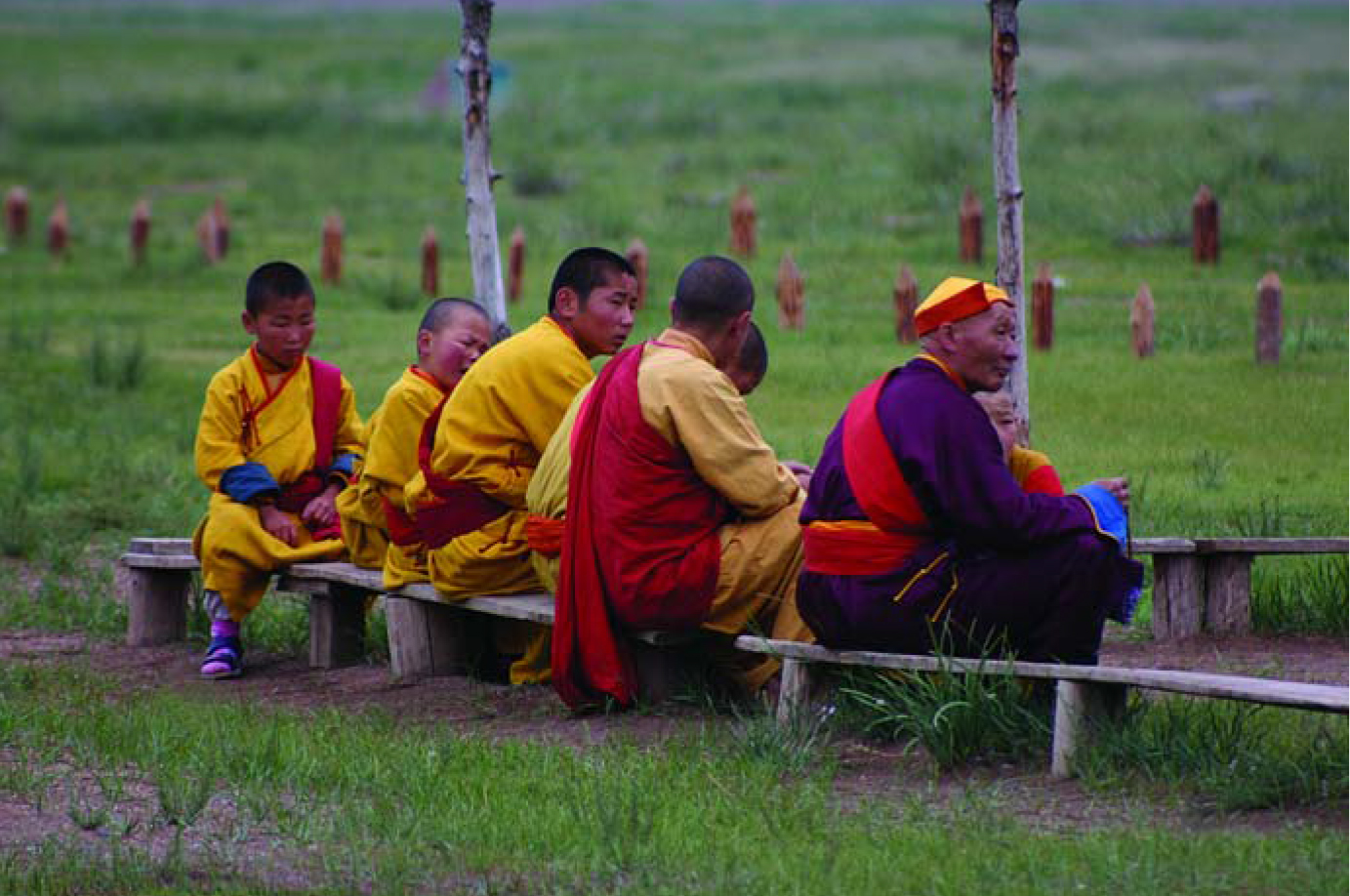
After breakfast we travel to the outstanding Tuvkhun Monastery, located at the peak of a
remote, wooded mountain. A short hike up the mountain path leads to this relaxing location where we will learn about the history of this important pilgrimage site and the heritage of its founder, the great religious figure Undur Gegeen Zanabazar, who produced many celebrated works of art at this site after choosing Tuvkhun for his meditation retreat in 1651. With an exquisitely peaceful view over the surrounding larch forest from an altitude of more than 2000 metres, you will have no trouble understanding why Tuvkhun is considered such a
sacred location. Overnight in ger camp (B, L, D)
Day 8: Naiman Nuur Lake
We will continue south from Tuvkhun Monastery in the direction of Naiman Nuur, the “Eight Lakes” stopping on the way for short hikes through the mountains of the Khangai Range, exploring crevices left by ancient earthquakes and gorges along the Orkhon River. Overnight in tents (B, L, D)
Day 9: Naiman Nuur Lake
Enjoy a challenging day of hiking in the area of Naiman Nuur, a natural formation of eight lakes situated 2200 metres above sea level, nestled in the forested Khangai Mountains. Extinct volcanic craters interspersed throughout these lakes create a breathtaking visual landscape. Overnight in tents (B, L, D)
Day 10: Orkhon waterfall
After breakfast we drive to the Orkhon waterfall - whose thundering cascades can be heard from far away. There is plenty of time to explore this area of crevices and other volcanic formations, stopping along the way to examine relics and historic sites associated with the ancient Turkic state, whose empire once extended across Central Asia. Overnight in tents (B, L, D)
Day 11: Taikhar Rock
Taikhar Rock, an immense natural monument situated incongruously in the middle of the steppe - offers an exotic contrast to the nearby riverbanks coated with colourful flowers and grasses, and the larch-covered mountains in the distance. Overnight in ger camp (B, L, D)
Day 12: Lake Terkhiin Tsagaan / Khorgo National ParkÂ
We travel west through beautifully forested valleys and meadows, stopping by exceptional spots such as Zuun Mod – the “Hundred Tree” – a sacred tree hidden by thick layers of blue scarves deposited by worshippers, and the stunning Chuluut River Gorge. Along the way we will also visit the museum in Tsetserleg, located in the former Zayiin Khuree Monastery, and examine the fascinating displays of authentic ethnographic and religious objects. We continue onwards to the great volcanic crater of Khorgo, which created a vast field of basalt formations and the 16-kilometre-long Terkhiin Tsagaan Lake, situated 2200 metres above
sea level, with a depth of 200 metres. A hike up to the summit of the volcanic crater is rewarded with a breathtaking view of the surrounding landscape, including the nearby lake. There are excellent opportunities during the rest of the day for birdwatching, hiking, horseback riding or fishing. Overnight in ger camp (B, L, D)
Day 13: Khangai Mountains
Now we head north to the Jargalan hot springs, crossing deep river basins and high mountain passes, and visiting nomadic families along the way. Overnight in ger camp (B, L, D)
Day 14: Murun
Our next destination is Murun, the capital of Mongolia’s northern-most province of Khovsgol. The ride itself is a scenic and adventuresome journey by 4×4 jeep through deep coniferous forests and across ditches, rivers and mountain passes. Overnight in tents (B, L, D)
Days 15 – 16: Lake Khovsgol
We arrive at the shores of the sacred Lake Khovsgol, Mongolia’s most popular destination for locals and foreigners alike. The lake is surrounded by breathtaking mountain and forest scenery. We spend the night in a Mongol ger-the traditional, felt-covered dwelling of the Mongolian people, heated with a wood stove and furnished with beautifully- decorated wooden-frame beds, providing an authentic and memorable taste of Mongolian culture.
Overnight in ger camp (B, L, D)
Day 17: Selenge River
One of Mongolia’s most important river, the Selenge is fed from lake Hovsgol and empties into Russia’s Lake Bikal. We’ll spend the day exploring this lake and the high mountains and beautiful vallies that surround it. Overnight in tents on the riverbank (B, L, D)
Day 18: Lake Sharga
Travelling off the beaten track, we head to Lake Sharga, beautifully situated in the Taiga and Khangai Mountain ranges. We will visit some local families and take in the natural beauty of this area in the heart of Mongolia. Overnight in ger camp (B, L, D)
Day 19: Amarbayasgalant Monastery
Next up is the city of Erdenet, one of Mongolia’s largest industrial centres. Nearby is
Amarbayasgalant Monastery. Built in 1736 in memory of Undur Gegeen Zanabazar, Amarbayasgalant is one of the few monastic complexes that survived
the religious purges of the 1930s nearly untouched, and remains one of the most significant monuments of Buddhist architecture in North Asia. Overnight in ger camp (B, L, D)
Day 20: Ulaanbaatar
The journey concludes in Ulaanbaatar, with the remainder of the day free for rest or shopping. After dinner, we’ll attend a performance of an ensemble performance of Mongolian folk art. Overnight in hotel (B, L, D)
Day 21: Departure
Our adventure together ends with your transfer back to the Buyant-Ukhaa International Airport for your departure.