
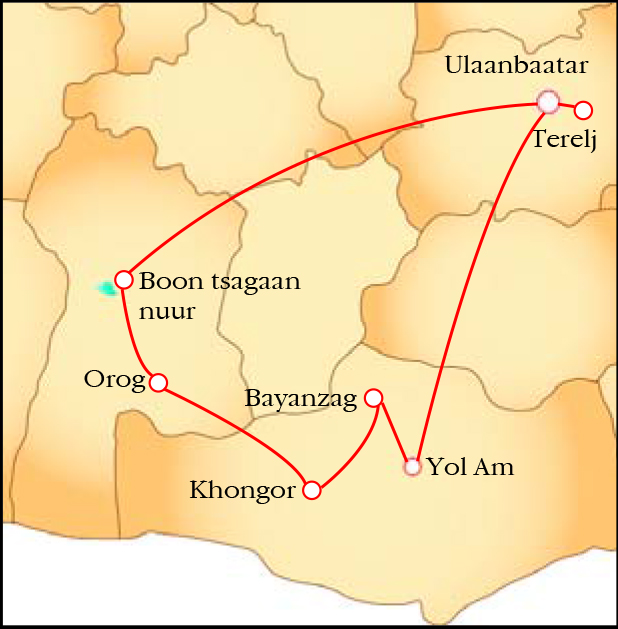
 In 2004, 203 varieties with a total of 468 species of birds were recorded in Mongolia . Of these species, 81 are always reside in the country, and 385 are migratory. Out of that number, 250 nest here in the summer, 52 just travel through, 10 come from Siberia to winter, 9 spend some time in the summer before passing through, and 64 are periodically present. According to these statistics only 17 percent of Mongolia ‘s bird species are permanent residents, however, 71 percent utilize Mongolia as their summer nesting grounds. The first migrations come to or through Mongolia around the tenth of March, but the main migrations occur from the middle of March until the 20 th of May. Lower altitude region (such as the Great Lakes Basin area) lakes, rivers and marshes begin to thaw from mid May, however ice does not melt from the high altitude region mountains, steppes, and plateaus until June. In June and July these birds migrate to special congregating areas to molt and regain stamina lost during the harsh winters. The autumn migration season begins in August for most species, and continues until the end of October. Sometimes, depending on the weather, the last birds migrate in the middle of November.
 Day 1: Ulaanbaatar
We will arrive in Ulaanbaatar in the early morning    and after checking into our hotel we’ll drive a short way out of town to the willow-fringed Tuul River and adjacent grass-covered Zaisan valley. Our eastern location will immediately become obvious with birds such as Black-eared Kite, Hill Pigeon, Forktailed Swift, and Red-billed Chough around the town. Once out into open country we’ll begin to get a taste of what birding in the heart of Asia is all about, with Richard’s and Blyth’s Pipits, Brown Shrike, Isabelline Wheatear, Daurian Redstart, Azure Tit, White-crowned Penduline Tit, Longtailed Rosefinch, and Meadow, Black-faced and Yellow-breasted Buntings all possible. Overnight in hotel. (B, L, D )
Day 2: Boon Tsagaan Nuur
Today we’ll begin our journey through this epic landscape. We will take an internal flight to the west of the country and set our sights in particular on the fabled lake of Boon Tsaagan Nuur. If time allows we’ll begin exploring this bird rich site. Overnight in tents. (B, L, D )
 Day 3: Boon Tsagaan Nuur Lake
A
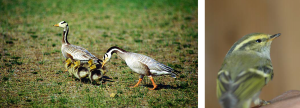
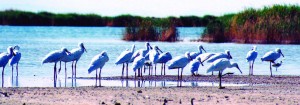
midst truly wonderful scenery this jewel of a lake is home to one of Asia’s most enigmatic birds, the striking Relict Gull. We will have plenty of opportunities to enjoy this rare gull in this remote wilderness. Of course there will be other birds, migrants and residents alike, to distract us. Brown-headed Gulls can occur here along with Great Egret, Eurasian Spoonbill, Whooper and Mute Swans, Bar-headed and Swan Geese, Falcated and Ferruginous Ducks, White-winged Scoter, Pallas’s Fish Eagle, Eastern Marsh Harrier, Great Blackheaded Gull, Gull-billed and Caspian Terns, Pallas’s Grasshopper and Paddyfield Warblers, and Pallas’s Reed Bunting. A variety of rarities such as Chinese Pond Heron have been seen here in the past, and the list of waders could include Greater and Lesser Sand Plovers, Gray-tailed Tattler, Asiatic Dowitcher, Broad-billed Sandpiper, Temminck’s and Red-necked Stints, and Terek Sandpiper.Overnight in tents. (B, L, D)
Days 4 – 5: Orog Nuur Lake
After another morning birding at Boon Tsaagan Nuur we’ll continue our journey. Driving east through the desert we’ll reach another lake, Orog Nuur, where we may find some species not seen at Boon Tsaagan Nuur. Birds en route should include impressive Mongolian Larks and the chance of seeing such sought-after birds as Henderson’s Ground-Jay and Pallas’s Sandgrouse. Around the lake we hope to see Black-necked Grebe, Ruddy Shelduck and Garganey, and in the nearby hills such diverse species as Chukar, Saker, and Rufous-tailed Rock Thrush. Overnight in tents. (B, L, D)
Days 6 – 7: Khongoryn Els Sand Dunes
Our drive takes us through some fantastic scenery as we pass under the shadow of the mountain massif of Ikh Bogd Uul which dominates the land scape. Our destination is Khongoryn Els in the Gobi Gurvan Saikhan National Park, home to some of the world’s largest sand dunes. This dry desert habitat will present us with some new species including Saxaul Sparrow, Steppe (or Saxaul) Grey Shrike, Desert Wheatear, and Asian Desert Warbler. The elusive Macqueen’s Bustard is also a real possibility, as is Goitered Gazelle. Overnight in ger camps. (B, L, D)
Day 8: Bayanzag or Flaming Cliffs
As we continue east we’ll reach the famous Flaming Cliffs, a spectacular sandstone gorge where we should find Lesser Kestrel, Isabelline Shrike, and Rock Sparrow before we end the day at the South Gobi Yurt Camp. Poplar trees planted several decades ago surround this camp. Today they not only provide shelter for the camp but also act as an oasis for passing migrants. Almost anything can turn up here from Common Kestrel and Hawfinch to Japanese Sparrowhawk, Taiga Flycatcher, and a variety of warblers and buntings. In the past, some new species for Mongolia such as Forest Wagtail and Black Drongo have been found here. Overnight in ger camp. (B, L, D)
 Days 9 – 10: Yoliin Am Gorge
We will make a 2 days trip to Yolyn Am, the Valley of the Lammergeier, in Gobi Gurvan Saikhan National Park. The wide open spaces that lead to the valley are where we should find Oriental Plover, a beautiful and seldom seen wader, as well as the possibility of Great Bustard and Greater Sand Plover. The lofty ridges of the valley are indeed patrolled by Lammergeiers as well as Eurasian and possibly Himalayan Griffons, Black Vulture and Golden Eagle. Other species we shall search for in this rocky habitat include Wallcreeper, Crag Martin, Water Pipit, the rare Kozlov’s and the much commoner Brown Accentors, Black Redstarts, Whitewinged Snowfinch, Great, Common, and Beautiful, Rosefinches and Godlewski’s Bunting. We’ll scan the higher slopes for Altai Snowcock and in doingso we may also see an Ibex or Argali, the largest wild sheep in the world. There may also be other eyes gazing upon these creatures as here we are in the territory of Snow Leopard. Although visitors have seen them in the past the chances of doing so are obviously very remote. We’ll spend most of the day around Yolyn Am for a second chance at some of its key species. Overnight in ger camp. (B, L, D)
Day 11: Ulaanbaatar
Today we drive the short distance to Dalanzadgad and connect with a flight back to Ulaanbaatar where we spend the night. Overnight in hotel. (B, L, D)
Days 12 – 13: Terelj National Park
As our tour draws to a close we’ll travel northeast of the capital to Tereldsh, a vast area of mixed forest that is essentially the southern edge of the mighty Siberian taiga. Birds here will be typical of that habitat and could include such Siberian delights as Daurian Jackdaw, Swinhoe’s Snipe, Oriental Cuckoo, White-backed Woodpecker, Siberian Rubythroat, Siberian Blue Robin, Darksided Flycatcher, Two-barred Greenish and Pallas’s Warblers, Long-tailed Rosefinch, and Pine and Siberian Meadow Bunting, to name a few. With luck some rarely encountered species such as Oriental Honey-buzzard, Black-billed Capercaillie and Redthroated Thrush might be found here as well. Our stay at a comfortable yurt camp set in beautiful forest scenery will be a pleasant and enjoyable end to our tour. Overnight in ger camp. (B, L, D)
Day 14: Ulaanbaatar
The journey concludes in Ulaanbaatar, with the remainder of the day free for rest or shopping. After dinner, we’ll attend a performance of an ensemble performance of Mongolian folk art. Overnight in hotel (B, L, D)
Day 15: Departure
Our adventure together ends with your transfer back to the Buyant-Ukhaa International Airport for your departure.